
A typical switchboard upgrade cost in Australia depends on the age and condition of your existing board, with a standard single-phase home being the most straightforward job. Larger properties, three-phase systems, damaged wiring, asbestos panels or major supply upgrades will push the total higher. A site inspection is the only reliable way to receive an accurate price.
Your switchboard distributes electricity safely throughout your home. If it still contains ceramic fuses, lacks modern safety switches or regularly trips, an upgrade may be necessary to protect your household and support today’s electrical demand.
What Does a Switchboard Upgrade Cost in 2026?
Straightforward residential upgrades sit at the lower end, while projects involving extra circuits, older wiring or a full board replacement cost more. Three-phase upgrades and jobs needing major alterations are the most involved of the lot. Every electrical installation is different, so the only accurate number is the one on your quote.
A practical guide to what each level of work involves:
- Basic upgrade: Straight swap of an older board with minimal rewiring
- Standard residential upgrade: New board, safety switches and updated circuits
- Complex or three-phase upgrade: Three-phase supply, asbestos panels or major rewiring
- Additional rewiring or supply work: Quoted after inspection
The quote should explain what is included, whether faults have been identified and whether further work may be required after testing.
What Factors Affect the Final Price?
The Size of Your Home
A small unit with a limited number of circuits generally requires less equipment and labour than a large family home. Properties with pools, workshops, electric vehicle chargers, solar systems, batteries or several air conditioners may need additional circuits and protection devices.
The electrician must also allow enough room for future electrical additions. Installing a board that is already at full capacity can create avoidable expenses when you later add another appliance or system.
Single-Phase or Three-Phase Power
Most standard Australian homes use single-phase power. Larger homes and properties with high-demand equipment may use three-phase power, which normally involves additional components and more complex testing.
Changing from single-phase to three-phase power can also require coordination with the electricity distributor. This is different from simply replacing an old switchboard enclosure, so it may substantially affect the quote.
Safety Switch Requirements
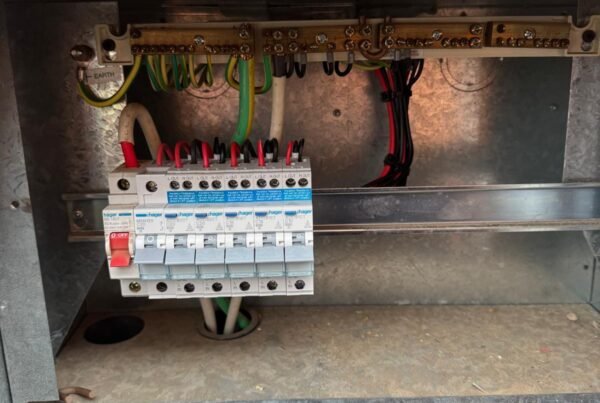
Modern switchboards generally include residual current devices, commonly called RCDs or safety switches. These devices monitor electrical current and quickly disconnect power when they detect certain faults that may place a person at risk.
Queensland’s Electrical Safety Office recommends safety switch protection across household circuits and advises residents to test each device every three months. Requirements can differ between states, property types and the type of electrical work being completed.
Existing Wiring Conditions
An electrician may find deteriorated insulation, overloaded circuits, incorrect connections or wiring that does not pass required tests. These problems cannot be safely ignored simply to keep the original quote low.
Older Australian homes may contain wiring that has been altered several times during renovations. Identifying and correcting undocumented work often requires additional labour.
Asbestos and Damaged Panels
Some older switchboard panels contain asbestos-based materials. These panels require suitable handling and disposal procedures, which can add to the project cost.
Cracked enclosures, heat damage, water entry, corrosion and pest damage may also require more extensive replacement work.
Access and Location
A clearly accessible board usually takes less time to replace than one located inside a cramped cupboard, behind fixed cabinetry or in a damaged external meter box. Regional travel, distributor fees and local labour rates may also influence the final price.
What Should Be Included in the Quote?
A professional quote should describe the work rather than providing only a single total. Depending on the installation, it may cover:
- Removal of outdated fuses and equipment
- Installation of circuit breakers and safety switches
- A compliant switchboard enclosure
- Circuit identification and labelling
- Inspection and electrical testing
- Correction of minor defects specified in the quote
- Required electrical safety documentation
- Removal of replaced components and site clean-up
Ask whether distributor fees, asbestos handling, surge protection and fault repairs are included. This helps you compare quotes fairly.
Warning Signs That Your Switchboard May Need Attention
Ceramic fuses alone do not always prove that an immediate replacement is legally required, but they are a clear reason to arrange an assessment. You should also book an inspection if you notice:
- Frequent tripping or blown fuses
- Buzzing, crackling or sizzling noises
- A burning or overheated smell
- Scorch marks or melted components
- Flickering lights when appliances start
- A warm switchboard cover
- Missing or limited safety switch protection
- No spare capacity for planned electrical work
Do not repeatedly reset a circuit that continues to trip. The safety device may be responding to a genuine fault.
Can You Reduce the Cost?
You cannot safely perform switchboard wiring yourself, but you can make the project easier to quote and plan. Prepare a list of future additions such as solar panels, an induction cooktop, air conditioning, a home battery or an electric vehicle charger.
You can also provide the electrician with previous electrical certificates and information about renovations. Clear access around the board before the appointment, but never remove covers or touch internal components.
Obtain a detailed written quote rather than automatically accepting the lowest price. A cheap estimate may exclude testing, safety switches, certification or necessary fault repairs.
Electrical wiring work must be performed by an appropriately licensed electrical worker. For example, NSW requires a licence or certificate for electrical wiring work regardless of its value, while Queensland also prohibits unlicensed electrical work.
When to Call a Professional
Call a licensed electrician promptly if the switchboard smells burnt, produces unusual sounds, becomes hot or shows visible damage. If there is smoke or fire, leave the property, stay outside and call Triple Zero on 000.
BTD Electrical & Data can inspect your existing board, identify its condition and provide a clear quote based on your property’s actual requirements. The assessment can also account for future appliances, solar equipment and additional circuits.
Never remove a switchboard cover or attempt to replace a fuse with improvised materials. Internal components may remain dangerous even when individual circuits appear to be switched off.
Conclusion
The total switchboard upgrade cost depends on the number of circuits, type of supply, condition of the wiring, access and safety equipment required. Most standard residential projects sit in a fairly predictable range, while complex work costs considerably more.
BTD Electrical & Data can assess your switchboard and explain which upgrades are necessary, which additions are optional and how the project can support your future power needs. Arrange an inspection before warning signs develop into a serious electrical failure.
Frequently Asked Questions
How long does a residential switchboard upgrade take?
Many straightforward upgrades can be completed within one working day. Complex faults, distributor involvement, asbestos materials or extensive rewiring may increase the timeframe.
Is replacing ceramic fuses worthwhile?
Modern circuit breakers and safety switches provide more practical fault protection than an old fuse-based setup. A licensed electrician can determine whether the complete board or only certain components need attention.
Do I need a switchboard upgrade before installing solar?
Not every solar installation requires a full replacement, but the board must have suitable capacity, protection and condition. An inspection should be completed during the planning stage.
Can I stay home during the work?
You can generally remain at the property, but the electricity will be disconnected for part of the job. Discuss medical equipment, refrigeration, remote work and other essential power needs before the appointment.